
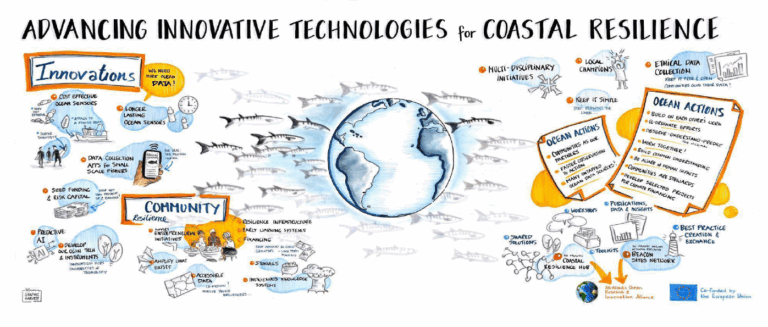
On 3 April 2025, the first OKEANO Advisory Mechanism workshop was held in Cape Town, South Africa. Organised by NRF-SAEON and aligned with the Ocean20 Engagement Group under the G20, the event focused on the theme “Advancing Innovative Technologies for Coastal Resilience” and brought together a diverse group of ocean experts, researchers, and community stakeholders.
The workshop explored how affordable and scalable technological solutions can support climate adaptation in coastal regions, particularly in developing countries. Discussions highlighted the critical role of community-led approaches, cross-sector partnerships, and innovative finance models in addressing the challenges of climate change along the coast.
Jonathan Heimer from the German Marine Research Consortium (KDM) presented the All-Atlantic Coastal Resilience Hub, showcasing a network of beacon sites and examples of practical solutions such as nature-based interventions, community monitoring tools, and open-access data initiatives.
Key action points included:
- Community-centric approaches: Co-design solutions with local communities to ensure relevance, ownership, and sustainability. Support capacity building for communities to access and use data, weather information, and early warning systems.
- Data accessibility and usability: Go beyond open access by improving data visualisation, interpretation, and translation for diverse users and increase visibility of existing data.
- Technology innovation & local development: Invest in cost-efficient, scalable, and locally produced ocean technologies. Promote the role of universities in developing instruments and building local technical capacity.
- Climate finance & investment strategies: Align funding mechanisms with long-term coastal resilience needs rather than short-term grants. Blend financing sources (e.g., seed funding, climate funds) to de-risk projects and attract further investment. Develop business cases around value addition to natural resources for sustained economic benefit.
- Artificial intelligence & emerging tools: Leverage AI for applications such as ocean safety, forecasting, sensor integration, and filling data gaps. Ensure ethical use of AI, especially with regard to community data.
- Partnerships & coordination: Foster multidisciplinary collaboration among academia, government, private sector, and civil society – building on the strengths of different specialities to maximise impact. Recognise communities not just as vulnerable populations, but as ecosystem stewards and key partners.
A visual summary of the event, created by graphic harvester Sonja Niederhumer, is included in the report.
The workshop was part of the All-Atlantic Ocean Research and Innovation Alliance (AAORIA) activities and will inform Ocean20 Ocean Actions under South Africa’s G20 contribution.
Read the full workshop report here
Watch the recorded session here
